How Indoor Climbing Builds Full-Body Strength
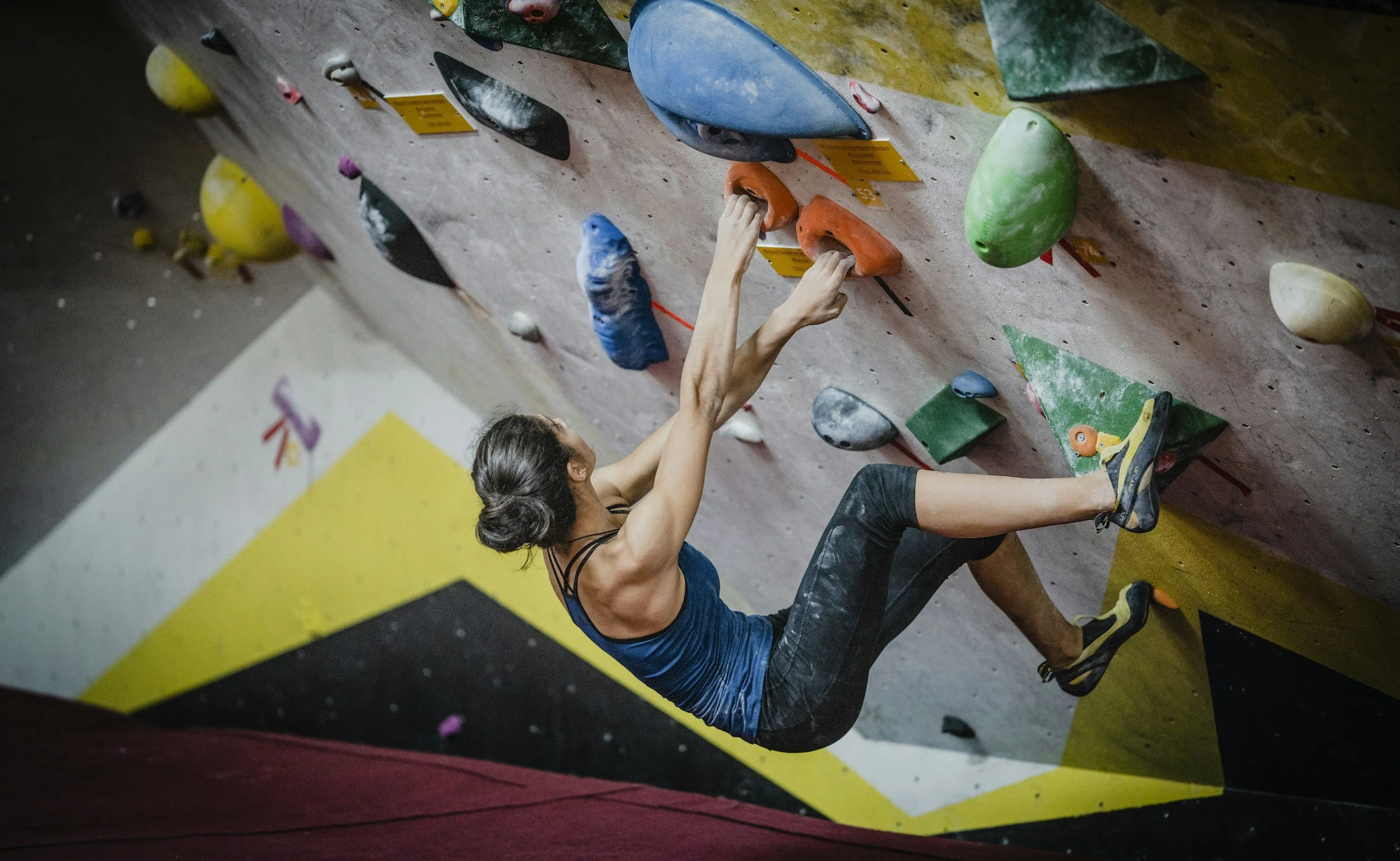
Indoor climbing can look like a test of grip strength, but every move asks more from your body. Your back pulls you toward the next hold, your core keeps you stable, and your legs drive you through the movement. Your fingers and forearms manage the holds while your shoulders, hips, and feet help you stay balanced. Your legs also help transfer load away from your forearms, which can delay the familiar forearm pump.
That combination makes climbing a practical way to develop full-body strength—even if you never step into a weight room. Climbing does have a clear bias toward pulling: the back, posterior shoulders, biceps, fingers, and forearms often work harder than the chest, anterior shoulders, and triceps. If you climb regularly, supplemental general strength work can help address that imbalance and round out your training. But if the climbing gym is the equipment you have—or the training environment you actually enjoy—it can still provide a challenging, repeatable strength stimulus.
Why Strength Matters for Longevity
Strength is more than a tool for climbing harder. It is also one of the most valuable physical qualities for longevity—the number of years you live—and healthspan—the quality of those years. As we age, muscle mass and bone density can decline, making strength important for maintaining the physical capacity required for everyday movement and independence.
That makes a sustainable strength routine valuable. The best routine is not necessarily the most complicated one; it is the one you can follow consistently. For many people, indoor climbing provides an enjoyable way to keep challenging their muscles, balance, coordination, and connective tissues over time.
The Principle of Progressive Overload
Whether you train in a weight room or on a climbing wall, strength gains depend on progressive overload: gradually increasing the demands placed on your body. That increase might come from more resistance, greater intensity, more difficult movements, or a training frequency your body can recover from.
Without a progressive challenge, your body has less reason to adapt, and progress can stall. Climbing does not usually involve adding external weight, but your body still has to move and control its own mass. A harder route, a smaller hold, a steeper wall, or a more demanding sequence can all change the load your muscles and tendons experience.
Indoor climbing is especially useful because it makes progression visible. Gyms offer repeatable climbs, clear objectives, scalable difficulty, and a community that can make it easier to keep showing up.
Consistency: Make Training Easy to Repeat
Consistency matters more than occasional all-out sessions. Indoor gyms remove several common barriers: they are not dependent on weather, they often have broad operating hours, and they give you a reliable place to train.
Choose a schedule you can maintain rather than chasing the hardest session every time. Regular practice gives your body repeated exposure to the movements and gives you more opportunities to improve technique, strength, and confidence.
Repeatability: Measure Your Progress
Repeating climbs may sound less exciting than constantly searching for a new challenge, but it is one of the clearest ways to apply progressive overload. Routes and boulders usually remain available for weeks or months before a gym resets them, giving you time to revisit the same problems.
Track useful markers such as:
Which climbs you complete
How many attempts you need
Which holds or moves stop you
Whether you can climb the problem with better control or less rest
You do not need a complicated system. A simple training log can show whether your performance is improving and help you choose an appropriate next challenge.
Simplicity: Reduce Friction
The simpler your routine, the easier it is to repeat. Indoor climbing gives you a straightforward objective: solve the movement challenge in front of you. You can choose a level that matches your ability, warm up, climb, rest, and try again.
That simplicity also makes it easier to build a habit. You spend less time designing a workout and more time practicing the skills and movements that matter to you.
Intensity: Increase the Challenge Gradually
To build strength, your sessions must eventually challenge your current capacity. You can improve technique and efficiency by climbing at the same level, but continued strength gains require some form of progression.
Use your gym’s grading scale as a guide, not a competition. When a level starts to feel manageable, try a climb that asks for a little more strength, tension, or control. You can increase intensity by choosing:
Smaller or less positive holds
Steeper terrain
Longer or more sustained sequences
More demanding movement combinations
Increase difficulty gradually and give your fingers, tendons, and other tissues time to recover. Stronger muscles do not eliminate the risk of overuse, especially in a sport that involves repetitive pulling and gripping.
Motivation: Use the Climbing Community
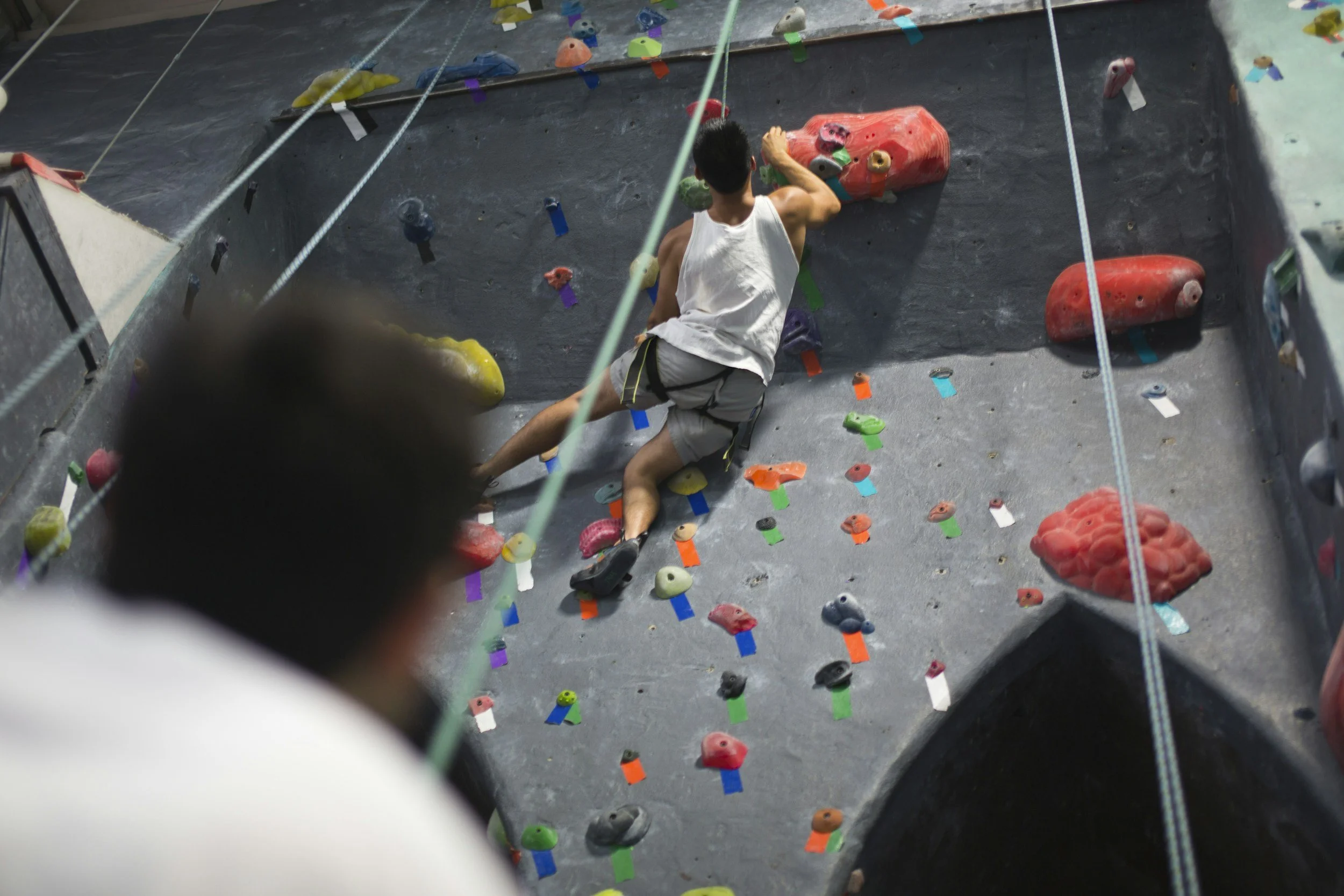
Self-motivation is not reliable. Some days you will feel excited to climb; on others, discipline and accountability will get you through the door.
Climbing gyms often make that accountability easier. Regulars share beta, celebrate small improvements, and encourage one another through difficult projects. A supportive community can turn training into a social habit, making it easier to stay consistent for the weeks and months that strength development requires.
Build Strength by Building a Sustainable Practice
Indoor climbing can build meaningful full-body strength because it combines bodyweight resistance with repeated practice and scalable difficulty. It is not a complete replacement for every form of strength training, and its pulling emphasis makes supplemental pushing work worth considering. Still, it can be an effective option for anyone who enjoys climbing and wants a strength routine they will actually follow.
Keep your routine simple. Return to climbs you can measure. Increase the challenge gradually, respect recovery, and use the climbing community for support. With time, those habits can help you climb harder while building the strength and physical capacity that support a longer, healthier life.